Accurate Portrait Drawing Method - Portrait 11
The idea of this project was to test whether a modified grid method would allow me to get an accurate enough drawing for a portrait. All portrait artists measure, one way or another. Eighth inch errors are easily seen as distortion by the human eye in a face. This is a version of the grid method, the oldest known enlargement technique. It was used in Egyptian tombs by at least 1,500 BC. But instead of drawing a complete grid, I'm just boxing important features, eye, nose, mouth, hand and marking edges with vertical and horizontal lines. Once marked over your image (I use a transparency if using a real photo), you transfer the lines to your digital image or paper. This method works exactly the same for both. I did this digital version first and I'm now doing a 19 X 25 pastel on paper of the same image to see how close I can get with the limited color range of pastel sets. I will post it when it is done.
The only difference with paper vs digital is you have to figure out scale. With digital you can just select your set of lines and then enlarge and place it wherever you want. To use on paper or canvas first draw the top and right lines where you want them to end up then pick one of remaining two max lines I used the left on this drawing and mark it on your paper where you want it. Measure and then divide by the original lf-rt size (use a calculator). This is your scale, say 3.234. I first check top to bottom to make sure the other direction is acceptable, if not reset your line and try again. Once you have a scale, you just need to measure the distances from the right line to all other vertical and from the top to all other horizontal. ALWAYS measure from the right (or left) and top, never between lines. This eliminates accumulated measuring error. Multiply these by your scale number and then mark them all out on the paper (digital is faster :) )
From this point all you need is the photo propped up where you can see it to look at while you draw, you never need to measure it again, which was the point of this exercise. Remember, if you are trying to do a portrait, facial features and the shape of the face must be exact if you want a likeness. Everything else can be whatever you want. I only drew a box around the hand. As long as a draw a woman's hand in the right place it will be fine, but I was very careful with the facial features.
On your grid, sketch in the entire drawing. Once I did this, I hid the grid layer and then redrew a pencil over the sketch making corrections as I went. This is what I will use to color. At EVERY step I am correcting the picture - drawing, values and colors until I decide that it is close enough for this particular project.
My digital drawing process derives from how I draw with pastel as I find it mentally very logical as I concentrate on one thing at a time. Step one locates edges (the drawing), Step two sets major values areas (for black and white) or value and color (for color - which is why people should de b&w first, if you can't do good 3D looking b&w you can't do color, since it is b&w PLUS color).
With pastels, paper will only hold a certain amount of chalk, which is why the first color is important, you can only add a certain amount of chalk over it to change the color, so the closer you are at the start, the better and cleaner it will look. So I work the same way in digital. I block in rough colors and values over the whole piece. It gives me a good idea of what the finished piece will look like and it is easy to see value and color errors this way as you want to correct them all now. I get the overall colors and values as good as I can before I do any detailed drawing. This way you don't have to back up and do things over, you are just progressing towards more and more accuracy and detail.
A major process that you can do with pastel is to blend colors. You have to either blend or cross hatch as pastel doesn't have that many available colors. Like oil paint, pastels blend well together. So that is my next step. I blend the colors trying to recreate the gradients that I see in the photo. I actually probably do more 'painting' at this stage than any other. I am constantly observing the reference. I'm not just blurring edges of color together. At the end of this stage I expect to have a slightly blurry version of my finished painting.
Next is any value/color correction needed anywhere. When the large soft areas are as correct as I think I can get them, I go section by section and redraw and detail each area, redrawing features, correcting the drawing and adjusting small color and value changes around them.
After detailing, I just look carefully to see what is still wrong and where I see issues I redraw and correct until I decide I'm done.
Since this is first method I have tried with a digital painting that I could easily also use with paper, I am redoing this same painting as a large pastel (first one I've done in several years) to see how close I can get.

Final Image. Includes correction of the hair on the chest that was too high.

This drawing method is a variation of the grid method - the world's oldest, used in Egyptian tombs. Here is a class example I never finished, a pastel where you can see the grid that was drawn on the paper to blow up a photo of an old master.

For this exercise I gridded the most important features. Boxed in right eye, mouth, hand sides and bottom of nose and rt and lt edges.

Moving the lines to my drawing image, I then did a rough sketch using the lines and looking at the photo.

Hiding the grid layer, I then drew my pencil layer over the sketch, again looking at the photo and correcting as I went. This is major step one for me.

I first draw in the eyes as my contrast reference for the rest. I start with a black pupil and a white highlight to give me a value range for completing the block in.

I then block in the face.

And then section by section until I have a block in of the whole image. This is major step two for me.

The next step is the first blend. An awful lot of the painting is done in this step as I'm dragging the color around trying to match the gradients I see in the photo.

Then section by section, I start correcting now that I can see the whole picture. Here I did the first detail pass on the hair.

I now add the background that I want so I can adjust to it.

First detail pass on the face.

I realized I needed to darken the background before matching the hair and dress edges.
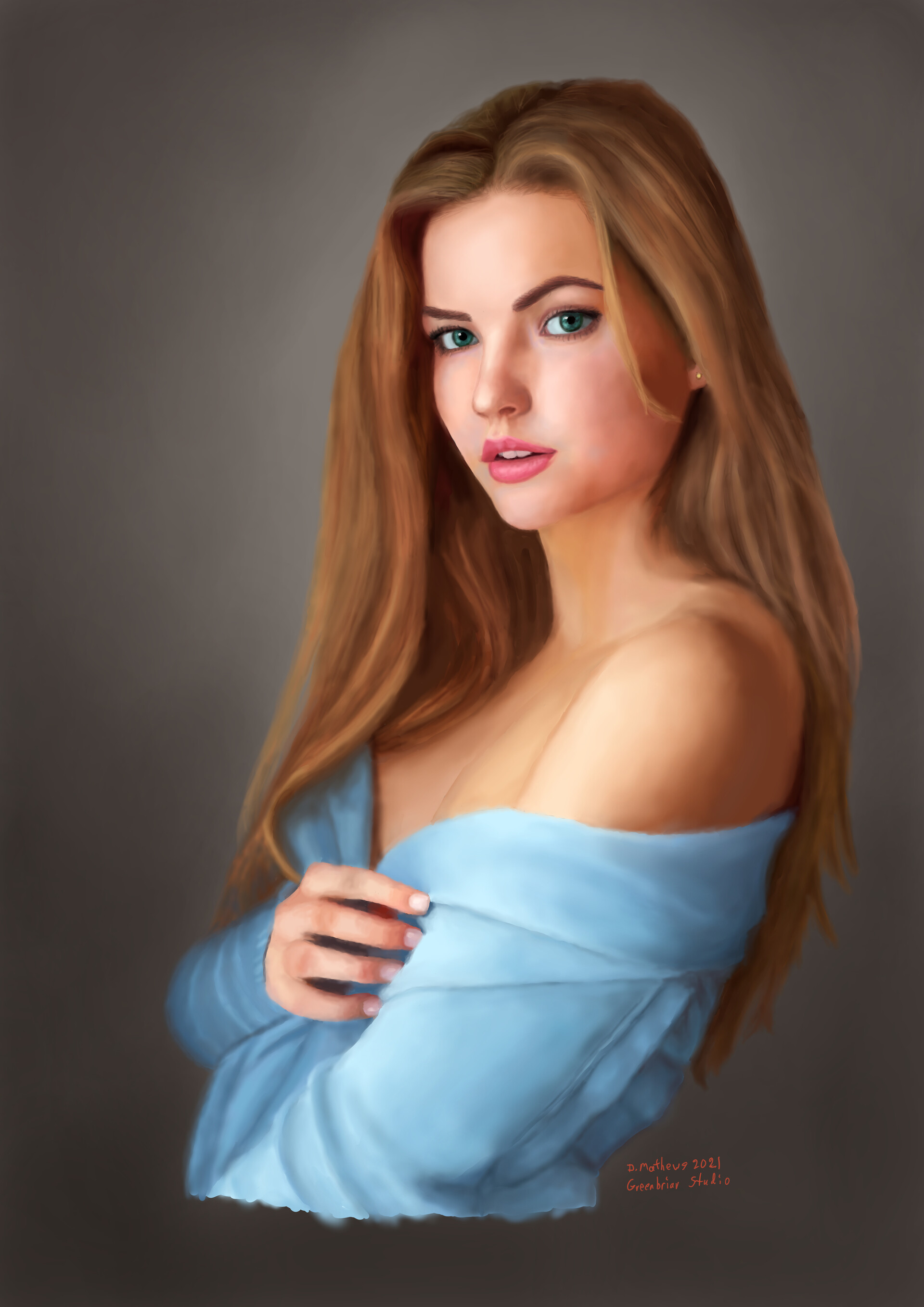
Dress detail pass. I purposefully lowered the contrast in the dress to keep the focus on the face.

Shoulder and neck detail.

Detail pass on the hand.